
MFA Without the Device Dependency
Extend TOTP authentication in Okta and Microsoft Entra to brokers, partners, agents, contractors and global help desks with a secure, browser-based virtual authenticator. No phone. No app to install. No authentication hardware to distribute.
Key Capabilities
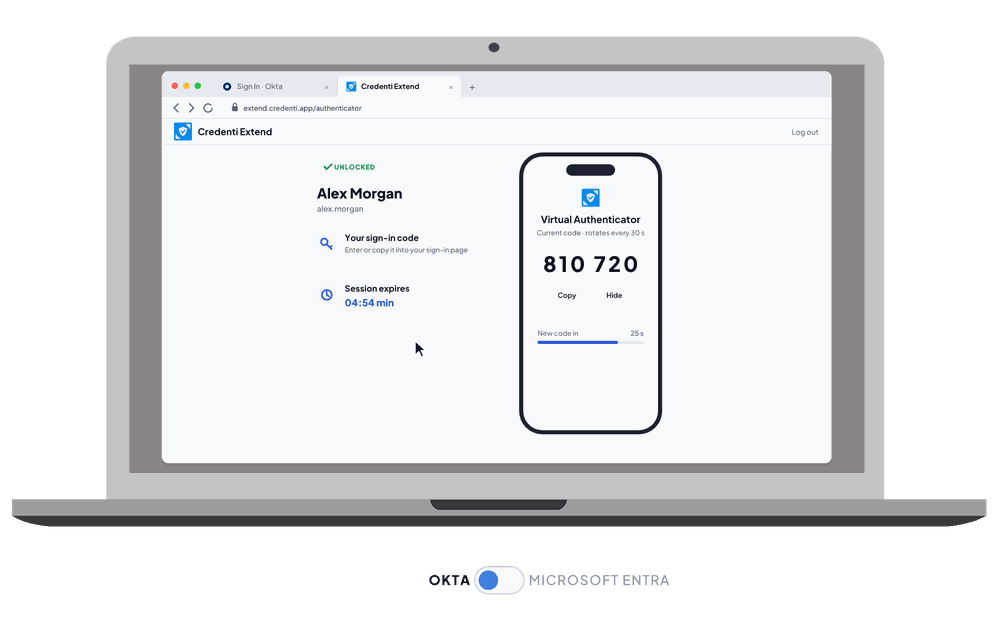
Browser-Based Virtual Authenticator
Users open Credenti Extend in a supported web browser to access their rotating six-digit TOTP code, instead of an authenticator app on a physical phone.
Phone-Independent Authentication
No mobile phone is required to retrieve the user's TOTP, and routine authentication does not depend on SMS or voice delivery.
No Endpoint Installation
Nothing needs to be installed on the user's workstation to access the virtual authenticator — ideal for personally owned and independently managed devices.
Okta and Microsoft Entra Integration
Works with TOTP in Okta and OATH TOTP in Microsoft Entra ID. Your identity provider keeps validating the code and enforcing your authentication and access policies.
Personal PIN Protection
When configured, a user-specific PIN protects access to the virtual authenticator — much like unlocking a phone before opening an authenticator app.
Phone-Free Enrollment
First-time activation verifies the user with a six-digit code sent to a registered secondary email that is independent of the protected Okta or Entra environment.

Benefits

No Phones, Tokens or Hardware to Manage
Stop collecting phone numbers, issuing corporate phones or shipping security keys around the world. There is no physical TOTP device to ship, recover or replace.
MFA on Devices You Don't Manage
Control application access without controlling the user's device — no MDM, admin rights or software installation needed on BYOD and partner endpoints.
Keep Your IdP and Policies
Okta or Microsoft Entra still validates every TOTP and enforces your existing authentication and access policies. Keep TOTP, remove the physical-device dependency.
A Simpler Device Lifecycle
Replace procure, inventory, ship, enroll, support, replace and recover with a simple flow: Verify, Enroll, Authenticate, Revoke.
How It Works
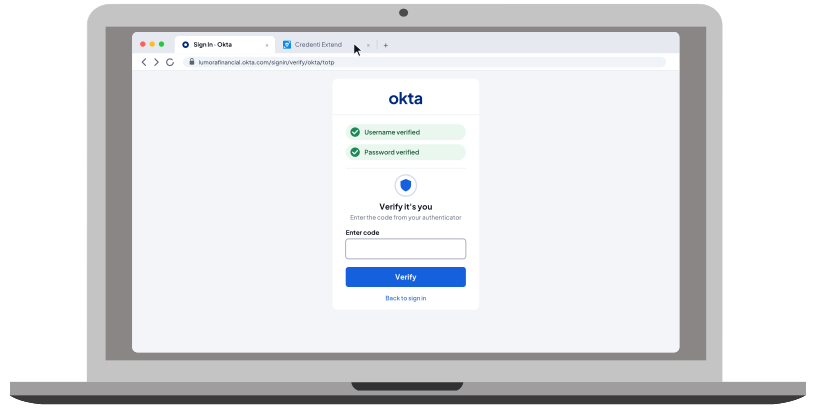
1. Open Credenti Extend
When Okta or Entra asks for a code, the user opens their Credenti Extend virtual authenticator in a supported web browser.
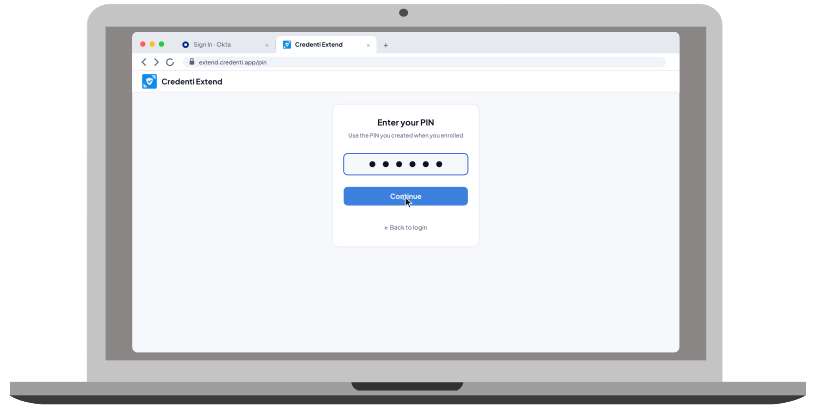
2. Unlock with a PIN
When configured, the user enters their personal PIN to unlock the virtual authenticator.
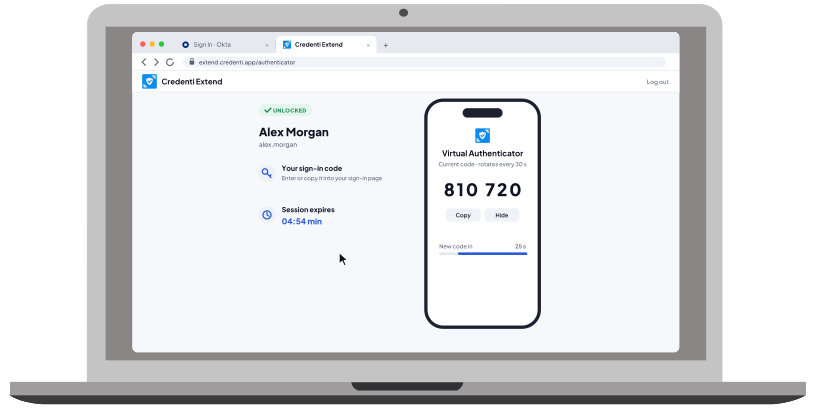
3. View the TOTP
Credenti Extend displays the current six-digit time-based one-time password, which rotates on the configured interval.
4. Authenticate and Keep Working
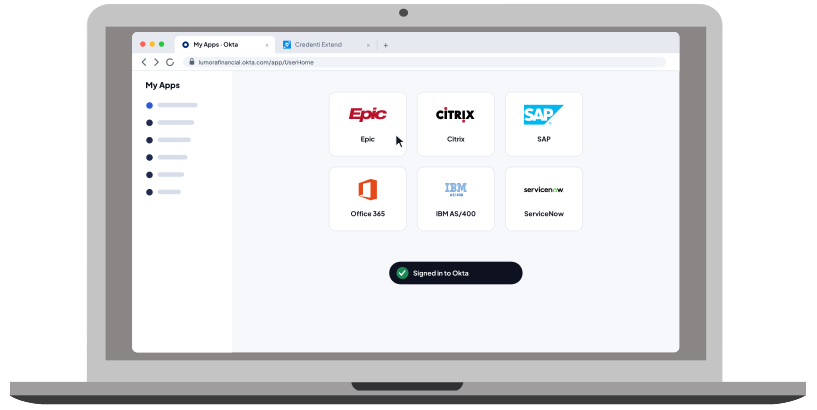
The user enters or copies the code into the normal Okta or Microsoft Entra prompt. The IdP validates it and applies your existing policies.
Built for the Extended Workforce
Brokers, Agents and Partners
Give brokers, financial agents, advisors and third-party partners enterprise MFA without issuing phones or installing software on devices owned by another organization.
Help Desks, Contact Centers and BPOs
Authenticate distributed, shift-based and high-turnover support teams without shipping authentication hardware or relying on personal phones.
Contractors and BYOD Workforces
Provide MFA to short-term and BYOD users without creating a physical device lifecycle or installing corporate software on their endpoints.
Frequently Asked Questions
What is Credenti Extend?
Credenti Extend is a browser-based virtual authenticator that allows users to access TOTP authentication codes without requiring a physical mobile phone, SMS, voice calls, authenticator application, or physical TOTP token.
Can I use MFA without a phone?
Yes. Credenti Extend provides a phone-independent way for users to access TOTP authentication supported by Okta and Microsoft Entra.
Does Credenti Extend require software installation?
No. Users access their virtual authenticator through a browser. No authenticator application, desktop agent, or browser extension needs to be installed simply to retrieve the TOTP.
Does Credenti Extend work with Okta?
Yes. Credenti Extend is designed to work with TOTP authentication supported by Okta. Okta continues to validate the TOTP and enforce the organization's authentication policies.
Does Credenti Extend work with Microsoft Entra ID?
Yes. Credenti Extend works with OATH TOTP authentication supported by Microsoft Entra ID. Entra remains responsible for validating the authentication code and enforcing authentication policy.
Is Credenti Extend replacing Okta Verify or Microsoft Authenticator?
Credenti Extend provides an alternative way to make TOTP available for populations where requiring a physical phone or authenticator application creates operational challenges. It does not replace the identity provider itself.
Does Credenti Extend replace SMS MFA?
Credenti Extend can provide a phone-independent alternative for appropriate authentication workflows currently dependent on SMS or voice OTP delivery. The user's TOTP is made available through their virtual authenticator instead of being delivered through a telecommunications provider.
Does Credenti Extend require a phone number?
No phone number is required to deliver the TOTP because the user retrieves it from the virtual authenticator rather than through SMS or voice.
How does a user enroll without a phone?
During first-time enrollment, Credenti Extend sends a six-digit verification code to the user's registered secondary email. After successful verification, the user can establish a personal PIN when configured and complete activation of the virtual authenticator.
Why does Credenti Extend require a secondary email?
The secondary email provides an independent channel for verifying the user during first-time enrollment. It should not depend on the same Okta or Microsoft Entra environment being protected.
Is secondary email used every time the user authenticates?
No. Secondary email is used for identity verification during enrollment rather than to deliver every TOTP authentication code.
How does the PIN work?
When configured, the PIN protects access to the virtual authenticator. The experience is similar to unlocking a physical phone with a PIN before accessing an authenticator application.
Is TOTP phishing-resistant?
No. TOTP is not considered phishing-resistant authentication. Organizations requiring phishing-resistant authentication should use methods designed for that requirement, such as passkeys or FIDO2/WebAuthn authentication where appropriate.
Credenti Extend addresses a different problem: making TOTP operationally practical for populations where phones, authenticator applications, security keys, or endpoint installations create significant barriers.
Who is Credenti Extend designed for?
Credenti Extend is particularly suited to brokers, financial agents, partners, contractors, global help desk personnel, BPO workers, contact center agents, temporary workers, and other extended workforce populations.
Can Credenti Extend be used in BYOD environments?
Yes. BYOD and independently managed endpoints are important Credenti Extend use cases because users can access their virtual authenticator without requiring the organization to install authentication software on the endpoint.
See Credenti Extend in Action.
Keep Okta or Microsoft Entra. Extend TOTP. Remove the device dependency — give brokers, partners, contractors and help desks enterprise MFA without a phone, an app to install, or hardware to ship.


